Nine Yoga Poses: Names, Supports & What to Notice
A pose chart is a useful way to recognise names, but it is not a complete lesson. The nine positions in this visual reference vary considerably in difficulty. Read these notes as an orientation before learning with an instructor. The phrase “gentle” on a poster does not make every pictured posture suitable for every beginner.
Supplied visual reference. Images may be illustrative or AI-generated and do not demonstrate verified technique.
Butterfly and a supported squat
Butterfly, often called Baddha Konasana, is a seated position with the soles of the feet together and the knees opening outward. A folded blanket under the seat and support beneath the thighs may make sitting more comfortable. Do not press the knees toward the floor. Malasana is a squat with the knees bent. Depth and heel position vary with mobility and proportions. A stable chair can offer a simpler supported sitting position; there is no requirement to copy a deep squat. Ask a teacher about support if knees, ankles or balance make the position uncomfortable.
Cobra and bridge: learn the setup first
Cobra, or Bhujangasana, is a prone backbend. A smaller lift with a long neck is a different choice from pushing the arms straight to reproduce the image. Learn the appropriate hand position and effort from a teacher. Bridge, Setu Bandhasana, begins lying on the back with bent knees and feet on the floor. The amount of lift should be comfortable; avoid turning the head while raised. These names describe families of positions, not instructions to lift as high as possible. Either pose can be skipped when it does not suit you.
Camel and bow deserve individual guidance
Camel, Ustrasana, and bow, Dhanurasana, are substantial backbends. Their appearance in a wellness collage does not make them introductory exercises. Reaching the heels in camel or the feet in bow is not a goal everyone needs. For a beginner, it is reasonable to leave these poses out and ask a qualified teacher for an alternative that fits the lesson. A photograph shows a finished shape without showing preparation, breathing, control or the process of coming out of the position.
Cat–cow and child’s pose can be adapted
Cat–cow, commonly taught using Marjaryasana and Bitilasana, involves a small, controlled change in the shape of the spine from an all-fours position. Padding may help the knees; wrist discomfort calls for an alternative rather than more pressure. Child’s pose, Balasana, folds the body toward the thighs. A cushion or a different resting position may be more comfortable. Neither position should be treated as a compulsory rest. Sitting on a stable chair or lying in a comfortable position can be a better choice for some people.
Legs up the wall and choosing your own rest
Viparita Karani is often shown with the legs supported vertically at a wall. Getting close to a wall, lifting the legs and remaining still are not comfortable or suitable for everyone. Ask about a supported alternative and how to enter and leave it. There is no need to force a right angle or stay until a timer finishes. The right ending to a practice is one you can settle into comfortably. The poster’s wellness captions are not individual medical advice or a guarantee of a particular benefit.
Your quick checklist
- Use the chart to recognise names, not to copy every pose.
- Support comfortable positions and omit unsuitable ones.
- Learn substantial backbends with individual instruction.
Common questions
Must I do all nine poses in one session?
No. This is a reference collection, not a prescribed sequence. A suitable class may use only a few of these positions or none of them.
Are camel and bow always gentle?
No. They can be demanding. Their suitability depends on experience, preparation and individual circumstances.
What if a common resting pose is uncomfortable?
Choose another comfortable rest and tell the instructor. A position does not have to work for you simply because it is commonly offered.
View the complete supplied reference image
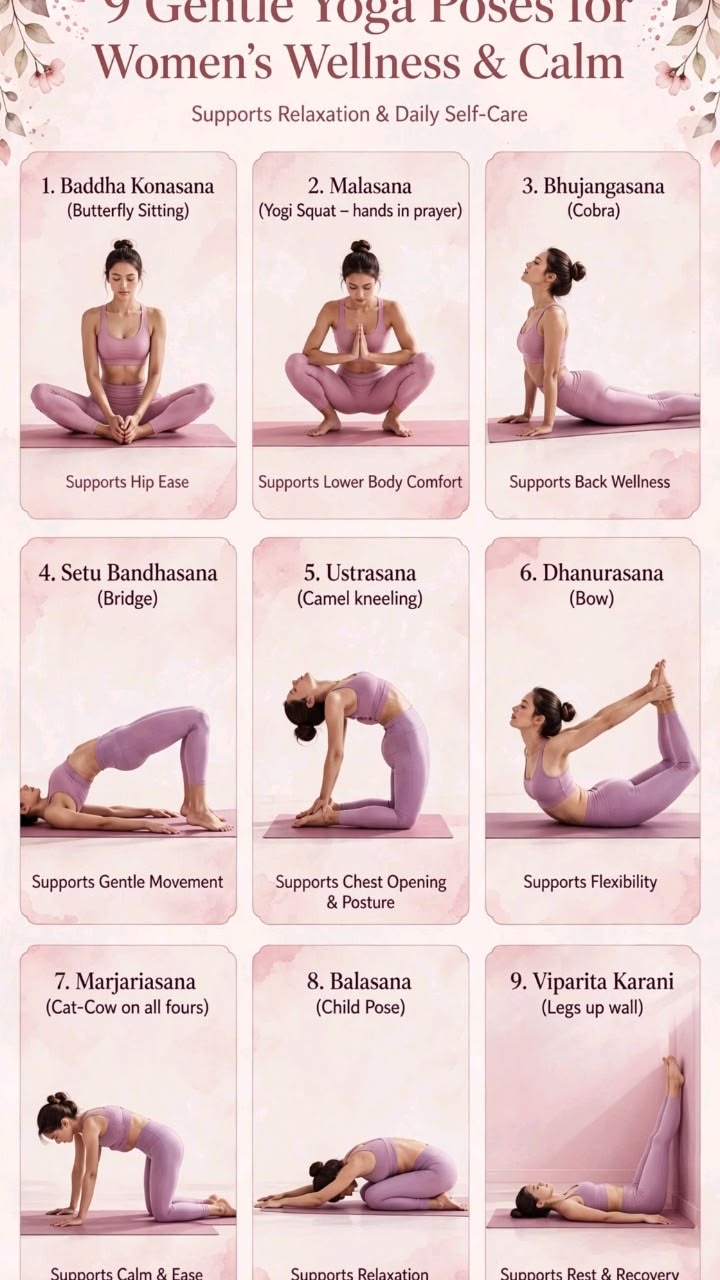
Original artwork supplied for this website. Captions and promotional claims inside the image are not clinical recommendations or a personalised programme.