Bolster or Folded Blanket? Describe the Support Instead of Copying the Picture
Two support arrangements can look similar on a screen and behave differently in person. A soft blanket fold, a firm rectangular bolster and a rounded cushion have different shapes and may compress differently. The useful question is not which one looks most like the photograph, but what the instructor intends the support to do and whether the actual arrangement is appropriate for you. This guide focuses on describing, checking and recording a taught setup rather than prescribing supported postures.
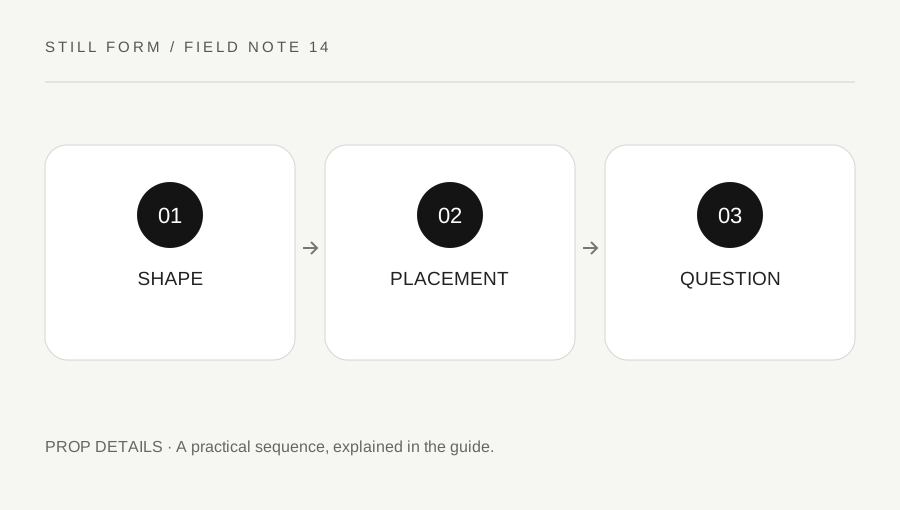
Original explanatory diagram. Examples illustrate a method or decision; they are not claims of personal testing.
Name the object and the intended role
Write bolster, blanket or cushion with a description of the actual item rather than using support as the only label. Record whether it is rectangular, rounded or folded, and ask what role the teacher intends it to serve in that lesson. A support shown under one person is not a universal template for someone with different needs.
Do not assume that softer means better or that firmer means more advanced. Those are material descriptions, not levels of achievement. The relevant instruction includes the object, its placement, the person and an appropriate way to enter and leave the arrangement. A single still image usually leaves several of those elements unknown.
Describe a blanket fold without overclaiming precision
A fold note can state how many layers or folds were used and which edges were aligned, if those details were actually taught. Keep the blanket identity in the record because thickness and compression can differ. Counting folds alone does not create a standard height across several different textiles.
Avoid turning household linen into a calculated load-bearing device. A folded blanket in a demonstrated support role does not establish that a stack of cushions is an equivalent substitute. Ask the instructor about the item you have. If the required arrangement is unavailable or unclear, request another suitable option instead of building a taller stack until the image appears to match.
Worked example: improve a vague photo caption
Imagine a saved image is captioned blanket under support. Replace that vague label with questions: Which blanket? How was it folded? Where was it placed? What was its purpose? How was the person instructed to move into and out of the position? Mark the questions unanswered until you have a reliable explanation.
A class note might later say rectangular bolster with one specified blanket fold, arrangement demonstrated by teacher, alternative requested for my equipment. This is a record of instruction, not a recipe for anyone reading the notebook. Keep the associated lesson and date so that the details are not detached from their original context.
Check condition, handling and the surrounding space
Use the manufacturer’s guidance for inspection, cleaning and storage of the actual equipment. Keep the area free of loose items that would interfere with the taught movement or with changing position. If a blanket edge or strap from another item trails across the area, resolve that before beginning rather than rearranging it while trying to follow a cue.
Ask how to change position if the arrangement is uncomfortable. A quiet class format can make people reluctant to interrupt, so clarify the communication method in advance. Silence and a calm-looking photograph do not mean that everyone must stay still regardless of comfort. Appropriate instruction should make the available choices understandable.
Record comfort observations without promising outcomes
Useful observations are specific and personal: the fold detail was hard to remember; the support shifted during setup; I need clarification before repeating this option. Avoid claiming that a support corrected alignment, treated pain or guaranteed relaxation based on appearance or one experience. Those are different claims requiring different evidence and, where relevant, professional assessment.
Before reusing the note, check that the equipment and intended lesson are still the same. A good support record can remain short: object, configuration as taught, purpose and unresolved question. Its value is clear communication. You do not need to collect more props or construct increasingly elaborate arrangements to make the notebook look complete.
A practical checklist
Choices are saved in this browser. Reset them here or clear this site’s browser storage.
Questions that come up
Does the same number of folds create the same height?
Not necessarily. Blankets differ in thickness, size and compression. A fold count is only part of a setup description.
Can I substitute several cushions for a bolster?
Do not assume that a similar-looking stack is equivalent. Ask the instructor about an appropriate alternative using your actual equipment.
Should I remain still if a support is uncomfortable?
Do not treat stillness as an obligation. Clarify suitable options and how to change position with the instructor, using individual professional advice when needed.
References & scope
Background references checked on 18 October 2026. Worked examples and diagrams are original teaching material.