Left, Right and Mirrored Yoga Cues: Make a Clear Orientation Note
A teacher facing the camera may appear to move one way while saying the opposite side. The recording may be mirrored, the teacher may be demonstrating as a mirror, or you may simply be viewing a different camera angle. It is easy to lose track when the instruction continues. Solve the orientation question before trying to follow unfamiliar movements. This is a guide to understanding references and making notes, rather than an instruction to copy a posture.
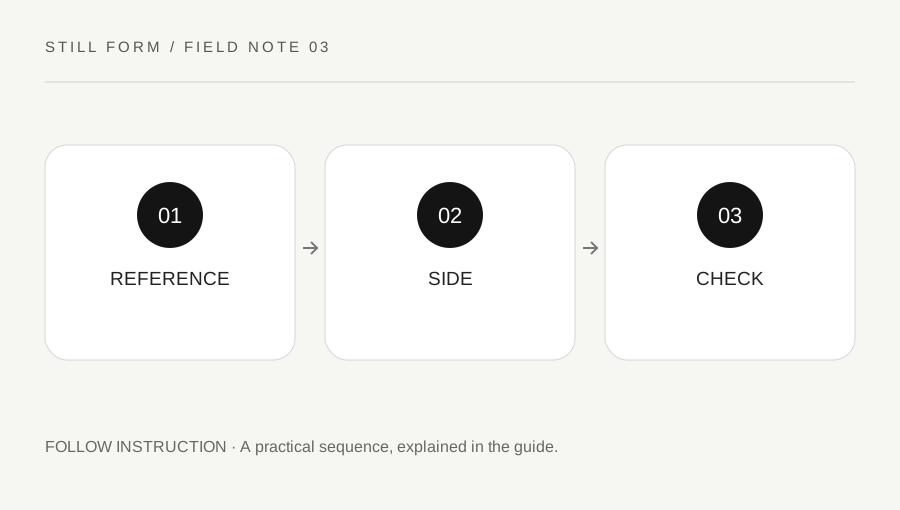
Original explanatory diagram. Examples illustrate a method or decision; they are not claims of personal testing.
Identify whose left and right are being named
Your left remains your left regardless of where the screen sits. A teacher’s spoken cue may refer to the participant’s side while the demonstration uses the opposite side to mirror the audience. Another teacher may demonstrate the same anatomical side and expect you to follow the words. Neither convention should be guessed from one gesture.
Look for an explicit explanation in the introduction or written instructions. If it is absent, ask the instructor how directional cues are used. Do not attempt to solve the question by moving farther into an unfamiliar position while trying to look at the screen. Pausing to understand the reference is a practical learning step.
Separate body sides from room directions
Forward can mean toward the front of the mat, toward the camera or in the direction the person faces. A teacher who turns around changes the relationship between those references without changing anatomical left and right. Write the reference explicitly: my left side, the short end of the mat nearest the wall, or the direction stated in this lesson.
A simple sketch of a rectangle with a named front edge can clarify your notes. It is a memory aid, not a requirement that every practice use the same orientation. If a class changes direction, update the sketch instead of assuming that front always means the edge closest to your device.
Worked example: audit a recorded explanation
Imagine a recording says right arm while the on-screen arm appears on your left side of the picture. Before participating, replay the introductory explanation and check whether the teacher says the demonstration is mirrored. If that remains unknown, mark the cue unresolved. A video image by itself cannot always establish the intended convention.
Create a note with three fields: spoken side, stated demonstration convention and remaining question. Do not add a performed-side entry unless you actually know what you did. The point is to identify the ambiguity, not to persuade yourself that matching the picture must have been correct. Choose clearer instruction if the ambiguity cannot be resolved.
Use a neutral label for tracking two sides
For an appropriate activity already taught to you, a notebook can use first side and second side alongside the actual side named in the lesson. This helps distinguish sequence order from anatomy. Write first side: right only when that is what the instruction specifies; do not make first side permanently mean right across every class.
If you pause a recording, record the timestamp and the next instruction rather than restarting from memory in the middle of a transition. Repetition counts and time spent listening are separate from side labels. A missed cue does not need to be repaired by adding extra repetitions or staying longer in a position.
Keep the screen from becoming another movement demand
Set up the viewing arrangement before the lesson and assess whether you can understand it without repeatedly turning to inspect the image. Captions, audible instruction or a preview may make the format clearer, but each still needs to match the actual lesson. Automated captions can misrecognize names and directional words.
If the class requires you to watch continuously from positions where the display is hard to see, ask about a more suitable format. A clear verbal explanation from a qualified instructor may answer the question better than rearranging furniture mid-practice. Understanding the cue is the task; exact visual imitation is not a useful substitute for appropriate instruction.
A practical checklist
Choices are saved in this browser. Reset them here or clear this site’s browser storage.
Questions that come up
Should I always copy the arm on the same side of the screen?
No. Screen position does not establish the teacher’s cue convention. Use the stated instructions and ask when they are unclear.
Does mirroring change my anatomical left side?
No. It changes the visual presentation. Your own side labels stay the same.
What if captions disagree with the spoken cue?
Pause and clarify using the source instruction or teacher. Captions can contain errors, especially with specialized names and short directional words.
References & scope
Background references checked on 18 October 2026. Worked examples and diagrams are original teaching material.