Read a Yoga Benefit Claim: Check the People, Programme and Measured Outcome
An advertisement can compress a complex research question into a promise that yoga will fix a problem. A study, however, concerns particular people, a defined programme and measured outcomes over a stated period. Those details matter before a result is applied to a different class or an individual decision. This guide gives a reading checklist for claims and a fictional example for practicing it. It does not diagnose a condition, recommend treatment or conclude that every positive or negative headline is reliable.
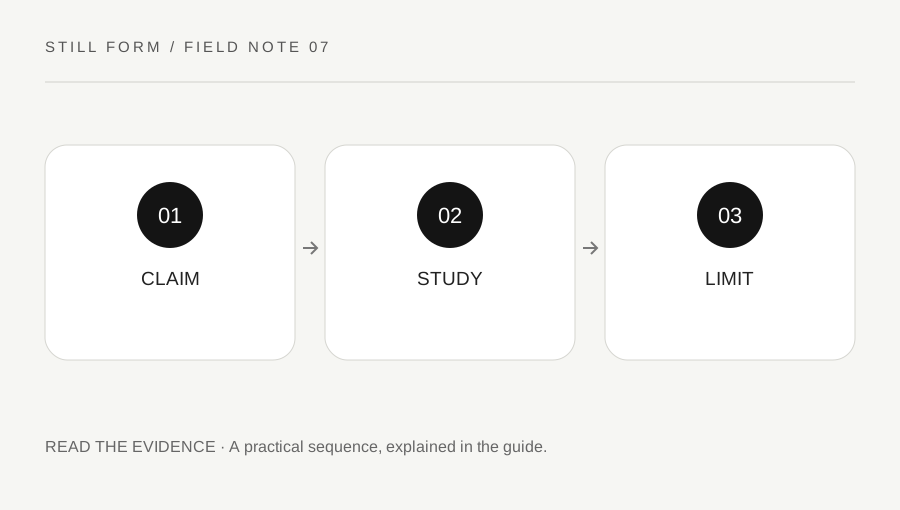
Original explanatory diagram. Examples illustrate a method or decision; they are not claims of personal testing.
Write the claim before looking for support
Copy the meaning of the claim into your own short sentence: which outcome is promised, for whom and with what certainty? Guaranteed relief for everyone is a much broader assertion than a reported average change in a defined group. Keep the exact outcome visible rather than replacing a specific statement with the general word wellness.
Then locate the source behind the claim. A testimonial, a promotional article, an individual study and a research review are different kinds of material. If the advertisement provides no identifiable study or reliable reference, mark evidence not supplied. A confident tone and a scientific-looking graphic do not fill that missing field.
Compare the actual programme with the advertised class
Yoga can include different components, formats and teaching methods. NCCIH notes that variation among yoga practices complicates comparison of research findings. Check what the study actually used: instruction, participant group, programme length and relevant context. Do not assume that any class with yoga in its title reproduces that intervention.
Ask whether the study describes additional care or activities. If participants received several things together, a headline may be oversimplifying what was evaluated. Do not turn a study schedule into your personal exercise prescription. Its role in the reading task is to define the research conditions, not to establish an appropriate plan for an unrelated individual.
Worked example: narrow a fictional headline
Consider an invented advertisement saying yoga guarantees better sleep in seven days. The linked fictional study instead concerns a specific instructor-led programme over several weeks, with a particular adult participant group and a questionnaire outcome. The advertisement has changed the timeframe, certainty and population before you even consider the statistical analysis.
Make a comparison table with rows for people, programme, duration, outcome and certainty. Put the advertisement and study description in separate columns, leaving unknowns blank. This exercise does not decide whether the study is good research; it first checks whether the claim describes the same question. A mismatch is a reason to reject the broader wording, not to invent a substitute promise.
Read results together with limitations
Check the comparison condition, number of participants, follow-up period and stated limitations. NCCIH’s research-literacy material explains that sample size can affect how findings are interpreted; a small study may leave substantial uncertainty. A larger number alone still does not answer every design or relevance question. Read the authors’ discussion rather than relying only on a headline.
Notice whether an outcome is self-reported, directly measured or something else, and whether the claim uses the same meaning. An average group result does not promise the same experience for each participant. Words such as may and uncertain carry information. Removing them can change the claim rather than merely shortening the sentence.
Use evidence as part of a suitable decision
For a medical question, bring the actual claim and source to an appropriate healthcare professional. Ask how the evidence relates to your circumstances and existing care. Do not stop treatment or replace an assessment because an advertisement describes a class as natural or traditional. A class organizer can describe their service, but that is a different task from individualized medical advice.
Keep the reading note modest: claim checked, source identified, mismatches listed and unresolved questions. You do not need to settle the whole research field to recognize unsupported certainty. Prefer descriptions that acknowledge the actual programme and limitations, and choose class information for its clear practical content rather than a promise that one activity will solve every problem.
A practical checklist
Choices are saved in this browser. Reset them here or clear this site’s browser storage.
Questions that come up
Does one positive study guarantee a benefit for me?
No. The study concerns defined conditions and a group. Individual suitability and medical decisions require appropriate assessment.
Is a testimonial equivalent to a clinical study?
No. A personal account can describe an experience, but it does not provide the same methods, comparison or evidence as a study.
Can I use a research programme as my own class plan?
Not automatically. A research schedule is part of the study description, not individualized instruction. Discuss relevant needs with suitable professionals.
References & scope
Background references checked on 18 October 2026. Worked examples and diagrams are original teaching material.