Gaze and Balance Cues in Yoga: Clarify the Focus Without Adding a Challenge
A teacher may ask you to look at a point, change gaze direction or keep attention on something steady. It can be tempting to turn that cue into a challenge by closing your eyes, removing support or copying a more demanding demonstration. Those are separate changes, not automatic interpretations of focus. This guide helps you record and clarify a gaze cue in a yoga lesson. It does not prescribe balancing postures or a programme to treat balance difficulties.
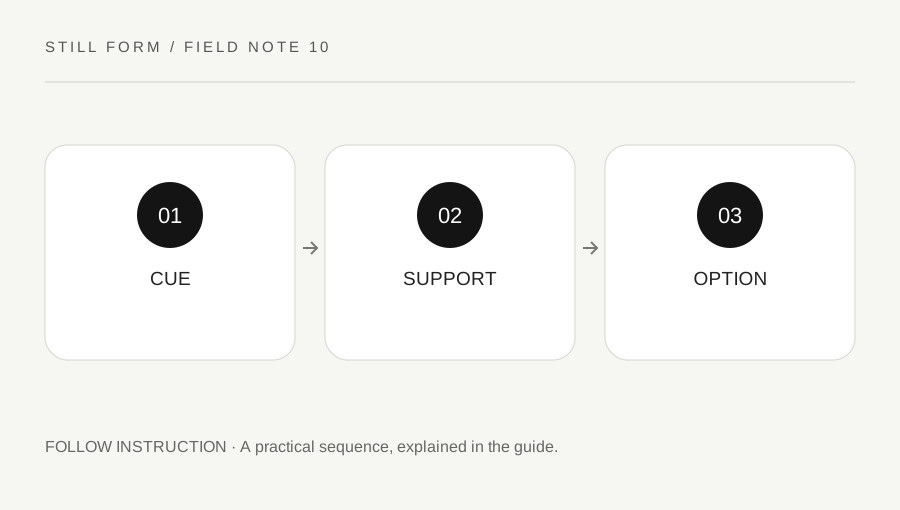
Original explanatory diagram. Examples illustrate a method or decision; they are not claims of personal testing.
Ask whether the cue concerns eyes or attention
Focus can refer to where you look, what you attend to or both. Ask the teacher to explain the intended meaning in the actual activity. A named gaze instruction may be part of a particular teaching method, but a label alone does not tell you what movement or visual demand is appropriate for you.
Record the spoken instruction rather than embellishing it. Look toward the named reference is different from turn the head, look upward or close the eyes. Do not add those actions merely to make the practice seem more concentrated. If the teacher’s demonstration and words appear different, pause and clarify the instruction before trying to reconcile them physically.
Keep support choices explicit
Ask what support or alternative the instructor intends, where it should be and how it is used in the specific lesson. NHS balance-exercise guidance includes consideration of a wall or stable chair for its activities, but that is not an instruction to adapt every yoga posture with any nearby object. The actual setup and individual requirements remain important.
A moving chair, loose piece of furniture or awkward reach is not validated by calling it support. If the available arrangement is unsuitable or unclear, choose another taught option or seek individual guidance. Support use does not need to be concealed from a notebook or removed to make a photograph resemble the demonstration.
Worked example: separate three changes
Imagine a teacher demonstrates an activity with one support arrangement and an eyes-open gaze cue. A later image shows someone without support and with eyes closed. Make three separate fields in your note: original activity, support arrangement and gaze instruction. The second image changes more than one thing, and it does not establish a progression you should attempt.
Ask which option the teacher actually intends for you and whether the image belongs to the same lesson or audience. If the answer is unknown, retain the original question rather than choosing the more dramatic photograph. Adding difficulty is not a necessary way to understand a cue.
Plan how to ask for a clearer reference
A gaze instruction can be hard to follow if the room reference is moving, obstructed or ambiguous. Ask for a verbal explanation that makes sense in your space. Online, a teacher’s reference point may not exist in your room, so copying the direction of their eyes may be unhelpful.
If vision or other individual needs affect the cue, discuss suitable options with an appropriately qualified professional and the instructor. Do not assume that a general focus suggestion resolves a balance concern. Avoid setting a personal target to remain in an uncertain position while trying to solve the visual instruction. Clarification can happen outside the activity.
Record useful learning rather than a maximum
A concise entry might say eyes-open cue clarified; support option discussed; room reference understood. That records learning without turning the lesson into a longest-hold contest. If you note duration, keep it descriptive and do not treat it as a recommendation for the next attempt or for another person.
Changes in a single observation do not diagnose a condition or prove a training effect. If you have concerns about balance or symptoms, seek appropriate assessment. For class selection, the relevant practical question is whether the teaching makes options understandable and respects your needs. An instruction can be successful because it becomes clearer, even when the chosen activity stays simple or is declined.
A practical checklist
Choices are saved in this browser. Reset them here or clear this site’s browser storage.
Questions that come up
Does a focus cue mean I should close my eyes?
No. Eye closure is a separate change. Do not add it unless it belongs to suitable instruction for your circumstances.
Is removing support the goal of every lesson?
No. Appropriate support and alternatives depend on the activity and person. Do not infer a progression from a photograph.
Can this article assess my balance?
No. It explains communication and note taking. Individual balance concerns require appropriate professional assessment.
References & scope
Background references checked on 18 October 2026. Worked examples and diagrams are original teaching material.