Read a Yoga Posture Photograph Without Treating the Silhouette as a Target
A posture photograph captures one person from one angle at one moment. It can help identify the subject of a lesson, but it cannot show everything needed to understand the instruction. Entry, exit, support choices and individual context may all be outside the frame. Use the image as a prompt for better questions rather than a template for your body. This guide explains an observation method for photographs; it does not assess alignment or teach a posture from appearance.
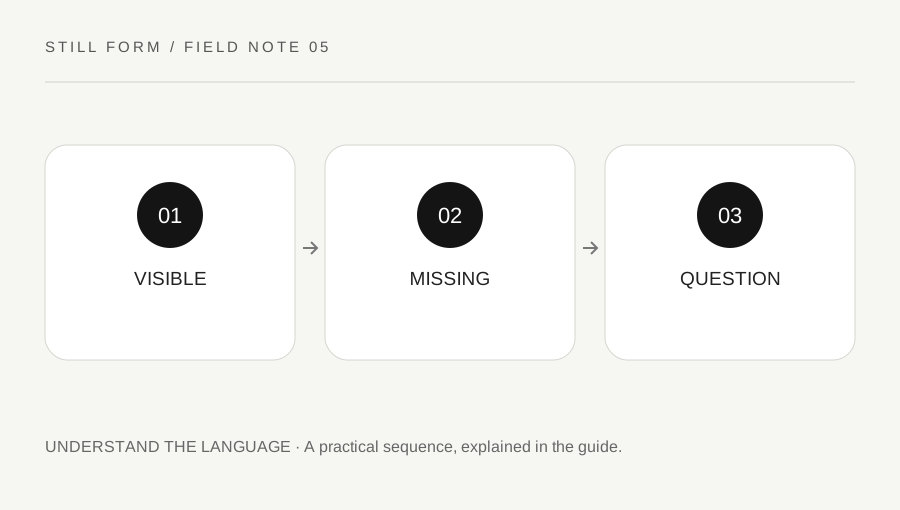
Original explanatory diagram. Examples illustrate a method or decision; they are not claims of personal testing.
List only what the picture actually shows
Begin with neutral observations: the person is on a mat; a block is visible; the photograph is taken from the side. Avoid turning those observations into conclusions such as the position is easy, the person is relaxed or the support guarantees safety. A still image does not establish sensation, effort, health history or suitability for someone else.
Keep the caption with the image because it may identify the lesson, variation or audience. If the caption is missing, mark that context unknown. An attractive cropped image can be useful illustration without being a complete tutorial. Recognizing that limited purpose prevents an illustration from carrying more authority than its actual information supports.
Identify information hidden by the frame
Ask what happened before and after the shutter moment. The photograph may not show how the person entered or left the position, how long it appeared in the lesson or what alternatives were offered. Objects and contact points can also be hidden by the viewing angle. Do not reconstruct those details by guessing from a silhouette.
A camera angle changes what overlaps and how distances appear in two dimensions. A limb that seems aligned with another object may simply overlap it in the picture. Measuring angles on a screenshot therefore does not create an individualized alignment assessment. Ask an appropriately qualified instructor about the actual instruction rather than trying to reverse-engineer it from pixels.
Worked example: use a three-column image note
Create columns labelled visible, not established and question. For a fictional photograph, visible might read one rectangular prop beside the mat. Not established could read exact dimensions, purpose, loading and entry method. The question becomes: What is this prop intended to do in the associated lesson, and what appropriate option would be taught with my equipment?
This method produces a useful question without copying the position. If a second photograph uses another prop, add a separate row instead of assuming it is a harder or easier version. The images may belong to different lessons, people or purposes. A visual difference does not automatically establish a progression.
Keep your own photographs in the same limited role
If you choose to document a taught activity, respect privacy and the instructor’s recording rules. Do not photograph other participants without their appropriate permission. For your own notes, identify the lesson and what the image is meant to record. Avoid treating one frozen frame as proof that an instruction was suitable or that a health outcome occurred.
Ask the teacher whether an image would actually help answer your question. A verbal description of an unclear transition may be more useful than several photographs of the final shape. If you share an image for feedback, use an appropriate professional context and understand that remote visual information has limits. Public comments are not an individualized assessment.
Choose learning questions over visual comparisons
A useful follow-up asks what the instruction means, how an appropriate option is taught and which details matter for the intended activity. It does not need to ask how to look exactly like the person in the picture. Differences in bodies and circumstances mean that matching a silhouette is not an appropriate universal goal.
If the image encourages you to force range, disregard discomfort or attempt an unfamiliar demanding position, step back from the comparison and seek suitable instruction. Keep the photograph in its role as illustration. A successful reading can simply identify what is visible, what remains unknown and the next question to ask, without performing anything shown in the frame.
A practical checklist
Choices are saved in this browser. Reset them here or clear this site’s browser storage.
Questions that come up
Can a photograph prove that a posture is safe for me?
No. An image cannot establish your individual needs or supply the full instruction and assessment relevant to you.
Is a deeper-looking shape automatically more advanced?
Do not infer a teaching level or progression from appearance. Ask about the actual lesson and appropriate options.
Should I measure joint angles on a screenshot?
A two-dimensional image and camera angle cannot provide a complete individual assessment. Ask a qualified instructor or relevant professional about your actual question.
References & scope
Background references checked on 18 October 2026. Worked examples and diagrams are original teaching material.